

A travel management company does more than book flights. It coordinates itineraries, accommodation, payments, expense records, traveller safety, supplier relationships and reporting. Corporate travel management brings these responsibilities together in a coherent programme, helping organisations oversee business journeys and their associated costs.
A well-run corporate travel management programme connects itineraries with accommodation, payment arrangements and the records finance teams need. It also gives travellers and administrators a clear framework for planning business trips.
This article explains what a travel management company does and how corporate travel management covers bookings, accommodation, payments and expense reconciliation. It also shows how these responsibilities fit together, when a structured approach is useful, and what to consider when implementing and monitoring a programme.
Key Takeaways
- Understand how a travel management company brings itinerary planning, accommodation, traveller care and reporting into one programme.
- Assess programme tools for usability, support and fit with existing financial or accounting systems.
- See how coordinated trip and accommodation bookings can give business travel a clearer structure.
- Learn how consistent payment records can support a more orderly expense reconciliation process.
Implementing and monitoring a travel management program
A corporate travel management programme needs clear policies, suitable tools and regular review. Implementation turns these elements into consistent decisions and useful reporting.
Corporate travel programme design
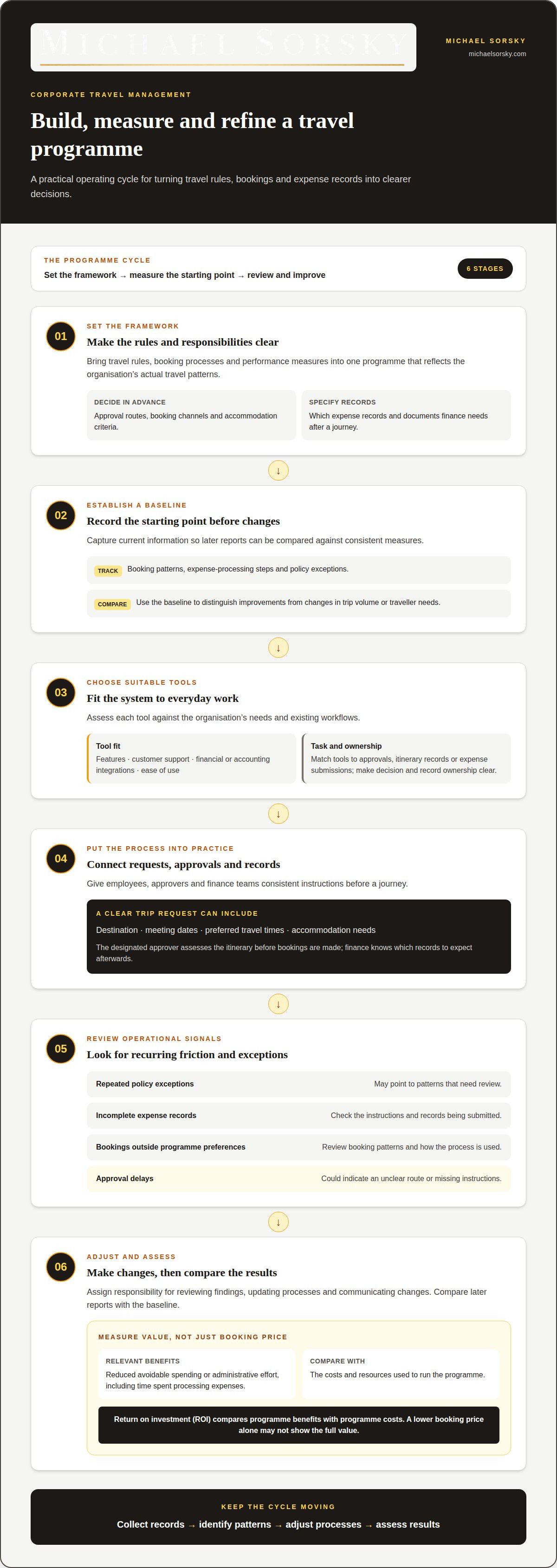
A corporate travel programme brings travel rules, booking processes and performance measures into one framework. Employees, approvers and finance teams all need consistent instructions before a journey. Define approval routes, booking channels, accommodation criteria and expense records. For example, specify who approves an itinerary and which documents finance needs afterwards. Clear steps help travellers follow the process and make later reviews more meaningful. A corporate travel management programme should reflect the organisation’s actual travel patterns.
Travel savings and return on investment
Travel programme savings are reductions in avoidable spending or administrative effort, measured against the resources used to run the programme. Return on investment, or ROI, compares those benefits with programme costs. A lower booking price alone may not show the full value. Include relevant costs and savings, such as time spent processing expenses and the effect of using preferred booking channels. Assess corporate travel management against these defined measures, not booking prices alone.
Establish a baseline before making changes. Record current booking patterns, expense-processing steps and policy exceptions, for example. Then compare later reports with those measures. Consistent comparisons help distinguish genuine improvements from changes in trip volume or traveller needs.
When selecting travel management tools, assess their features, customer support, integration with existing financial or accounting tools, and ease of use. These factors determine whether a system fits daily workflows. Match each tool to a specific task, such as approvals, itinerary records or expense submissions. Clear ownership also helps teams understand where each decision and record belongs.
Monitoring should connect policy use with operational results. Review reports for recurring exceptions, incomplete expense records and booking patterns that differ from programme preferences. Repeated approval delays, for instance, may point to an unclear route or missing instructions. Assign responsibility for reviewing findings, updating processes and communicating changes. This creates a clear cycle: collect records, identify patterns, make adjustments and assess the results.
What is a travel management company?
A travel management company coordinates business itineraries, bookings, traveller safety and reporting. Its work connects travel arrangements with an organisation’s policies and operational needs.
There is no single leading company for every organisation in the United States. The right fit depends on programme needs, customer support, available features, accounting integrations and ease of use.
Traveller safety and risk management
Traveller safety and risk management involve planning for foreseeable disruptions and supporting informed decisions during business trips. Employees may face changing conditions across destinations and itineraries. A travel programme can keep trip details accessible, establish internal escalation routes and communicate relevant updates. For example, a delayed connection may require changes to ground transport and accommodation at the same time.
Safety compliance concerns
Safety compliance means keeping travel guidance aligned with changing destination regulations and guidelines. Employees need current information to travel safely and comply with local laws. Organisations can assign responsibility for monitoring relevant updates, then communicate changes through travel instructions. A revised entry requirement, for example, may affect documents or itinerary timing, so travellers need clear guidance before departure.
Accommodation safety deserves its own consideration. The Bibby Stockholm began housing asylum-seekers at Portland Port, Dorset, on 7 August 2023. After positive Legionella tests on board, 39 asylum-seekers were evacuated on 11 August 2023. This UK case is not a corporate travel benchmark; it illustrates why accommodation concerns can require prompt attention and coordinated decisions.
For business travel, risk planning should connect traveller, itinerary and accommodation details. A named internal contact, accessible trip information and a clear escalation process help teams respond coherently when plans change. Regularly reviewing travel guidance also keeps programme communications relevant as destination conditions evolve.
Trip planning and booking accommodations
Business trip planning connects the purpose, itinerary and accommodation in one workable schedule. A client meeting, for example, can shape flight timing, hotel location and ground transport.
Corporate travel booking platforms
A corporate travel booking platform brings journey and accommodation options into a shared booking environment. This lets travellers and administrators work from consistent trip details. A planner can organise a route around meeting locations, then consider nearby accommodation. Keeping itinerary information together also helps teams see how a change to one booking affects the rest.
An earlier meeting, for example, may require an overnight stay rather than same-day travel. Reviewing arrival time, check-in arrangements and the distance to the venue helps create a practical itinerary. Accommodation can also be chosen to suit the traveller’s schedule and the purpose of the visit, rather than treated as a separate decision.
Booking and approval technology
Booking and approval technology supports the submission, review and recording of travel requests. A clear approval path connects proposed arrangements with organisational policy. A request might include the destination, meeting dates, preferred travel times and accommodation needs. The designated approver can then assess the itinerary before bookings are made.
Assess tools for their features, customer support, integration with existing financial or accounting tools, and ease of use. An awkward approval workflow, for example, can create friction even when booking details are easy to enter. Map the approval stages, identify who handles each decision, and choose tools that suit those steps.
Planning also requires coordination across the itinerary. A changed departure may affect hotel arrival, while a revised meeting time can alter transport plans. Recording these connected details helps administrators understand the impact of a change. Clear communication then gives the traveller an updated schedule, rather than separate instructions for each booking.
Once travel is arranged, keep itinerary and booking records together. A hotel confirmation alongside meeting dates, for example, can clarify which stay relates to which journey. These organised records also give finance teams a useful reference when reviewing submitted travel expenses.
Corporate travel payments and expense reconciliation
Travel payments connect each booking with the organisation responsible for its cost. An employee might use a company payment method for a hotel, while another approved expense is reimbursed later. Clear payment arrangements help travellers understand what to pay directly and which records finance needs afterwards. In corporate travel management, setting these arrangements in advance keeps payment responsibilities clear.
Set out the payment route for each travel expense before departure. A flight may be paid centrally, for example, while the traveller pays for meals and claims them later. The booking record, payment evidence and expense submission should identify the same trip. This gives finance a practical basis for matching transactions with business travel.
Expense reconciliation compares submitted claims with available receipts, booking details and payment records. Finance can start by grouping documents by traveller and trip. Then match each expense to its supporting evidence, flag missing receipts and resolve unclear descriptions. A hotel invoice, for instance, should match the accommodation dates recorded for that journey. These records help corporate travel management reports reflect the expenses associated with each trip.
Consistent categories make comparisons easier to interpret. A business can distinguish accommodation, transport and meals in its expense records, then apply its own approval rules. If a receipt describes a charge only as “miscellaneous”, finance may need more context. A brief explanation linking the charge to a meeting or journey can clarify its purpose.
Timing matters when closing out expenses. Travellers should submit claims promptly after a trip, and approvers need a clear route for reviewing them. Finance can then compare claimed amounts with card statements or booking records, identify duplicates and correct coding errors. Recording how each discrepancy was resolved creates a clearer trail for later reporting.
For example, a hotel charge may appear both on a central statement and an employee claim. Comparing the invoice with the payment record helps identify whether the claim duplicates a centrally paid booking. A consistent reconciliation process also gives programme reports more reliable expense data. Discuss your travel requirements when coordinated trip arrangements and financial records need closer alignment.
Michael Sorsky: Corporate Travel Management
Michael Sorsky provides corporate travel management for organisations coordinating business itineraries and executive travel. Its services suit situations where trip planning, flight arrangements and accommodation need a connected approach. Corporate Travel Management coordinates these arrangements, while Luxury Accommodation supports the lodging needs of business journeys. Global Concierge Services can also coordinate wider arrangements during international trips.
An international itinerary, for example, may require flights to align with meeting dates and accommodation to suit the schedule. Coordinated planning also clarifies responsibilities across the journey, from preparation through to the traveller’s stay. The right support depends on the organisation’s travel needs and the level of coordination required.
Contact Michael Sorsky to discuss your organisation’s corporate travel requirements.
Set a considered direction for future travel
Start by deciding what business travel should enable for your organisation. Consider which journeys are essential, where consistency matters most and who should own decisions as needs evolve. These priorities give your travel programme a clear purpose beyond processing the next booking or expense claim.
As expectations change, revisit how the programme supports business leaders and travelling employees. A focused discussion can identify where specialist coordination would help and how corporate travel management can better reflect your organisation’s priorities. Michael Sorsky can discuss an approach suited to your requirements and the standard of travel experience your business expects.
When you’re ready to consider the next stage, discuss your travel requirements with Michael Sorsky. A considered conversation can help bring greater clarity to the journeys ahead.
Frequently Asked Questions
What is corporate travel management and what services does it include?
Corporate travel management is the coordination of an organisation’s business travel arrangements and related administration. It can include arranging journeys, managing supplier relationships, recording expenses, processing reimbursement requests and producing travel reports. A report, for example, may help finance identify which departments submit travel expenses and where approval workflows cause delays. Responsibilities depend on the organisation’s programme and how its travel tasks are divided.
How does a corporate travel management company work?
A corporate travel management company works with an organisation to coordinate travel within its business policies. The organisation sets priorities and approval responsibilities, while the company arranges agreed travel requirements. An executive itinerary involving several cities, for example, may need coordinated flights and suitable accommodation. After the trip, clear records help the organisation review bookings and expenses. The working relationship depends on the agreed scope of support.
How do corporate travel management platforms compare on features and usability?
Platforms differ in how well their features support an organisation’s actual workflow. Rather than judging a tool by its feature count, test a representative task, such as submitting an itinerary for approval and retrieving its booking record. Consider whether users can follow each step, whether financial tools integrate appropriately and how support handles operational questions. A platform that suits administrators but confuses travellers can create avoidable friction.
What are the benefits and drawbacks of using a travel management company versus booking travel in-house?
A travel management company can centralise coordination, while in-house booking gives an organisation direct control over each task. External support may suit teams with complex itineraries or limited internal capacity. In-house arrangements may fit simpler travel needs, but staff must handle bookings, changes and records themselves. The deciding factors include trip complexity, internal expertise, approval needs and how much control the organisation wants over daily arrangements.
How can a company choose and implement a corporate travel management solution?
Start by defining the travel tasks, users and reporting needs the solution must support. Map how a request moves from traveller to approver, booking and finance, then assess whether the proposed system fits that flow. Test it with a realistic itinerary, including a change to meeting dates. Before wider adoption, assign responsibility for user guidance and review feedback so unclear steps can be improved.
What should a corporate travel policy cover, including booking and expense rules?
A useful policy explains who can approve trips, how employees should book and what information to retain. It should clarify accommodation expectations, payment methods, receipt requirements and the process for claiming eligible expenses. Specify, for instance, how a traveller records a business meal and links it to a trip. Include a route for exceptions so unusual schedules or urgent itinerary changes receive clear, consistent handling.